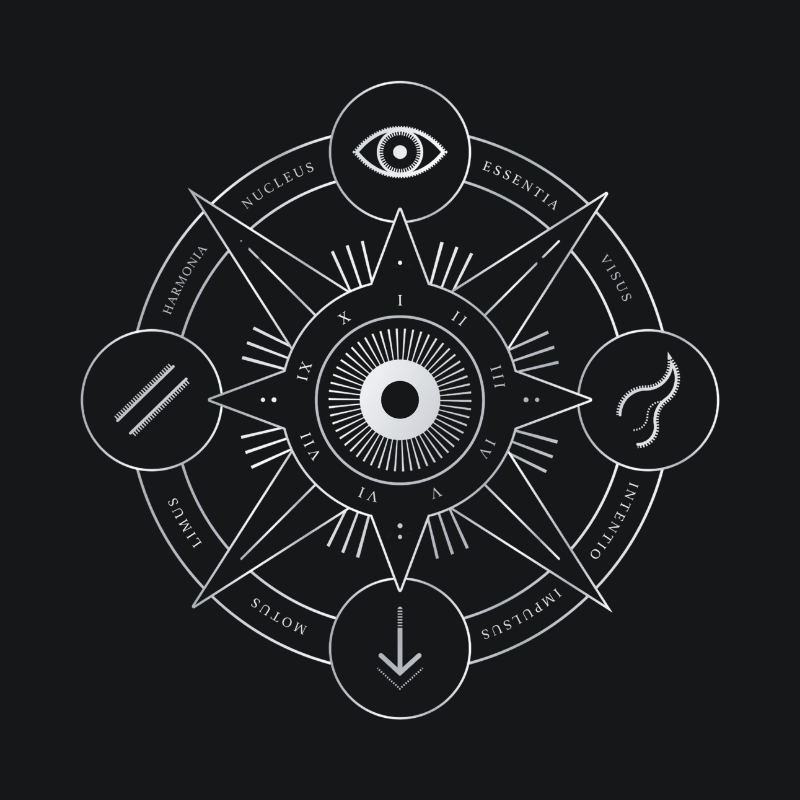
Why you skate. Who you are when you move.
Core is not about how to skate.
It is about why you skate.
This principle shifts the focus away from technique and outward validation, and brings attention back to intention, motivation, and authenticity. It asks deeper questions. What draws you to skating? What keeps you coming back? What kind of movement feels true to you?
In this chapter, you learn why creativity, style, and flow are not optional extras, but fundamental forces that shape how skating develops. Your preferences, your rhythm, and your personality all influence the physics of your movement.
Core teaches you to trust your internal compass instead of external reference points. When you understand your why, style stops being something you chase and starts being something you reveal.
Direction creates movement. Attention creates intention.
Skating begins with where you look.
Gaze is about vision, direction, and intent. Your eyes guide your body long before your skates touch the ground. Where you look determines how you enter a movement, how you hold balance, and how confidently you move through space.
This principle trains awareness. It teaches you to lead with intention instead of reaction. To skate forward, backward, or sideways with clarity instead of tension.
When your Gaze is clear, movement becomes purposeful.
Lines connect.
Hesitation disappears.
Your relationship with the floor.
Push is not about force.
It is about connection.
This principle focuses on how you interact with the ground beneath you. Pressure, timing, weight, and release. Push teaches you to move through zero-wheeling, grounding, and subtle shifts rather than hard acceleration.
Instead of avoiding the floor, you learn to work with it. To generate motion from balance, not effort. This is where skating becomes efficient, quiet, and sustainable. You skate pr0-active, taking control whether than just reacting.
A refined Push creates smooth flow.
It keeps you grounded.
It allows you to skate longer, calmer, and more controlled.
Where skating takes shape.
Edge is where Wizard-style Skating truly opens up.
This principle moves you beyond linear skating into wider, curved, and dynamic paths. By learning to trust your edges and rocker, you discover that bigger arcs create more stability, not less.
The wider you move, the easier it becomes.
The easier it becomes, the closer you can move.
Edge teaches how to control speed, shape space, and transition smoothly between movements. It is where skating becomes three-dimensional and expressive, without losing control.
Total body engagement. Expression through completion.
Tail is about everything you are not yet using.
It brings awareness to the free leg, the upper body, rotation, and extension. This principle teaches you that Wizard-style Skating is not driven by the feet alone. True style requires the full body to participate.
Through Tail, you learn how to use your free leg for balance, direction, rhythm, and expression. You begin to understand how arms, torso, hips, and legs form one continuous movement chain.
When Tail comes alive, skating becomes complete.
Movements feel finished.
Style emerges naturally.